












When Allison Dukes, Ph.D., was growing up in the late ’90s and early 2000s, police officers showed up in fifth and sixth grade classrooms with a straightforward message for students: Don’t use drugs.
“I had cops come in and tell me everything that I should or shouldn’t do,” Dukes said. “The cop has the gun on the belt, and there are scare tactics.”
Dukes was a child of D.A.R.E., a K-12 program that stood for Drug Abuse Resistance Education. The police-forward curriculum, founded in 1983 by the Los Angeles Police Department, spread nationwide and was a staple in U.S. classrooms through the early 2000s.
For Dukes, assistant professor and fieldwork coordinator in St. Joe’s graduate clinical mental health counseling program, this approach left out two key components of substance abuse prevention: It didn’t trust students to think critically, and it spoke at students rather than with them.
Today, Dukes serves as faculty advisor of Prevention Academy, a program that aims to flip that model by giving K-12 students tools to create healthy decisions. Launched in 2024 through St. Joe’s school of education and human development, Prevention Academy is funded by opioid settlement dollars distributed through Delaware and Montgomery counties. Since then, the program has expanded rapidly, reaching nearly 20,000 students across the two counties. Its services are available to any district within those counties.
Instead of law enforcement delivering statistics, the program relies on storytelling, data and dialogue from program specialists in the community, many of whom are in long-term recovery. Instead of assuming students are likely to make unhealthy choices, they start from the opposite premise.
“They’re making wonderful choices,” said Taylor Moran, M.S. ’26, associate director of the academy. “We are highlighting them. For me, I want them to acknowledge that and to recognize that and celebrate that.”
Building a solution from the ground up
When Dukes was asked in 2023 to help shape a new prevention effort funded through the opioid settlement money, she and her colleagues formed a working group rather than immediately designing a curriculum.
“We decided that our mission of a working group would be to collect information about the people who support kids and take care of kids today and ask them what’s going well and how we can support that,” Dukes said.
The responses highlighted a complex picture. School administrators were concerned about students’ mental health. Substance use, particularly with alcohol, vapes and cannabis, was often normalized as a rite of passage. And while parent involvement was seen as critical, school officials found it harder to engage families.
Those insights became the foundation for Prevention Academy’s community-informed model.
In classrooms, that means interactive sessions built around discussion, storytelling and role-playing. Prevention specialists share personal stories that connect abstract concepts to lived experience.
“We deliver our content in a way that gives them the information, but we’re also telling them what our experiences were,” said Moran, who is in long-term recovery.
Dukes describes storytelling as the program’s “secret sauce.” It creates an entry point for students to engage as participants rather than passive listeners.
That shift matters, Dukes said, because students often say the adults in their lives don’t listen to them. The classroom becomes a space where their perspectives are invited and taken seriously.
“They feel like we’re talking to them like little adults in a way, and we’re trying to really show that we value their opinion and input,” Dukes said.
Kierston Simon, M.S. ’08, executive director of Prevention Academy, said prevention works best when it’s proactive, relationship-driven and rooted in trust.
“Our goal is not to lecture or dictate choices but to engage students in honest conversations, elevate their voices and help them develop critical thinking skills,” Simon wrote in an email to The Hawk.
Correcting misconceptions
One persistent challenge Prevention Academy tries to address is perception.
After a prevention specialist speaks to a class, students are asked to complete an anonymous survey. This survey assesses their understanding of substance use, perceptions of peer behavior and access to support systems. It also has an open-ended feedback section where students can write how they felt about the presentation.
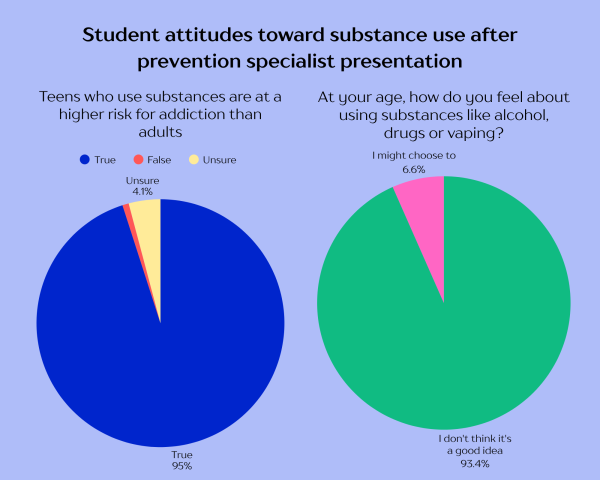
“The overwhelming majority of students are indicating that they’re choosing to not use substances, but they continue to think that students, their peers, are using substances and that they’re in the minority,” Dukes said.
One analysis of surveys following a school visit showed that in response to the question, “Do you think the majority of teens use substances like alcohol, drugs or vaping,” 63 students (52.1%) said yes, 35 students (28.9%) said no and 23 students (19%) said they were unsure.
That misconception can drive behavior. If students think substance use is the norm, they may feel pressure to conform. Prevention Academy tackles this by highlighting accurate data about peer behavior to reduce perceived pressure.
For Dukes, the contrast with earlier prevention models is clear.
“If we scare kids into making certain decisions, then maybe we’re missing an opportunity to correct some of those misconceptions or give them the information to make these healthy choices,” Dukes said.
Prevention Academy instead emphasizes informed decision-making. Lessons incorporate brain development, risk perception and coping strategies, helping students understand how choices affect them in the long term.
Archbishop John Carroll High School in Radnor has been partnering with Prevention Academy for two years. Bill Gennaro, the school’s principal, said students often become disengaged after constant exposure to the same classroom voices and that bringing in outside perspectives helps reengage them.
“With Prevention Academy, we feel their process of speaking to our kids for three straight days lets them build rapport with our students to get their message across,” Gennaro wrote in an email to The Hawk. “We would not be giving up this class time if we didn’t see it as important.”
For Caroline Heffernan ’25, brand and social media manager and prevention specialist for Prevention Academy who is also in long-term recovery, the program is invaluable.
“It’s giving kids information that I wish I was given,” Heffernan said.
Measuring impact
Prevention Academy measures success through a combination of quantitative and qualitative data. The student survey is just one tool that helps inform the work of Prevention Academy and schools.
After the surveys are summarized to identify trends, they are sent back to the school to help administrators understand the current trends among their students and how to give them more support. The program also compares student feedback with reflections from prevention specialists to identify gaps and tailor their training to meet the specific needs of each school.
“We’re not just coming in for a week and then leaving,” Dukes said. “It’s ‘How can we maybe support you in decision-making to support the long-term success of the students?’”
In addition to the student survey, Prevention Academy is in the process of establishing a county-wide youth survey called Development of Empowered Life Choices and Outlooks, or DELCO. The survey, according to Simon, is designed to assess trends and track changes over time in substance use, mental health and related risk and protective factors among students. The program currently has 1,100 responses that graduate assistants are coding to be published.
For Moran and Dukes, the next step is clear: expanding the program’s reach.
“All students deserve to have this conversation to support their well-being,” Dukes said.
And the conversations appear to be working.
“I like that the main idea wasn’t to just not do drugs and alcohol but rather be aware of what we put in our bodies when we do consume these substances,” one student wrote in their survey. “This will help me more to try and stay away from them.”
This is the sixth story in a series by Cara Santilli ’24, M.A. ’26, about social issues affecting the Philadelphia community, how the media reports on those issues and what the community can do to help.
Members of the St. Joe’s community seeking support are encouraged to contact the following resources:
Counseling and Psychological Services (CAPS), 610-660-1090
Campus Ministry, 610-660-1030
The Office of Student Outreach & Support, 610-660-1149
The Jesuit community, 610-660-1400
Employee Assistance Program, 866-799-2728