





























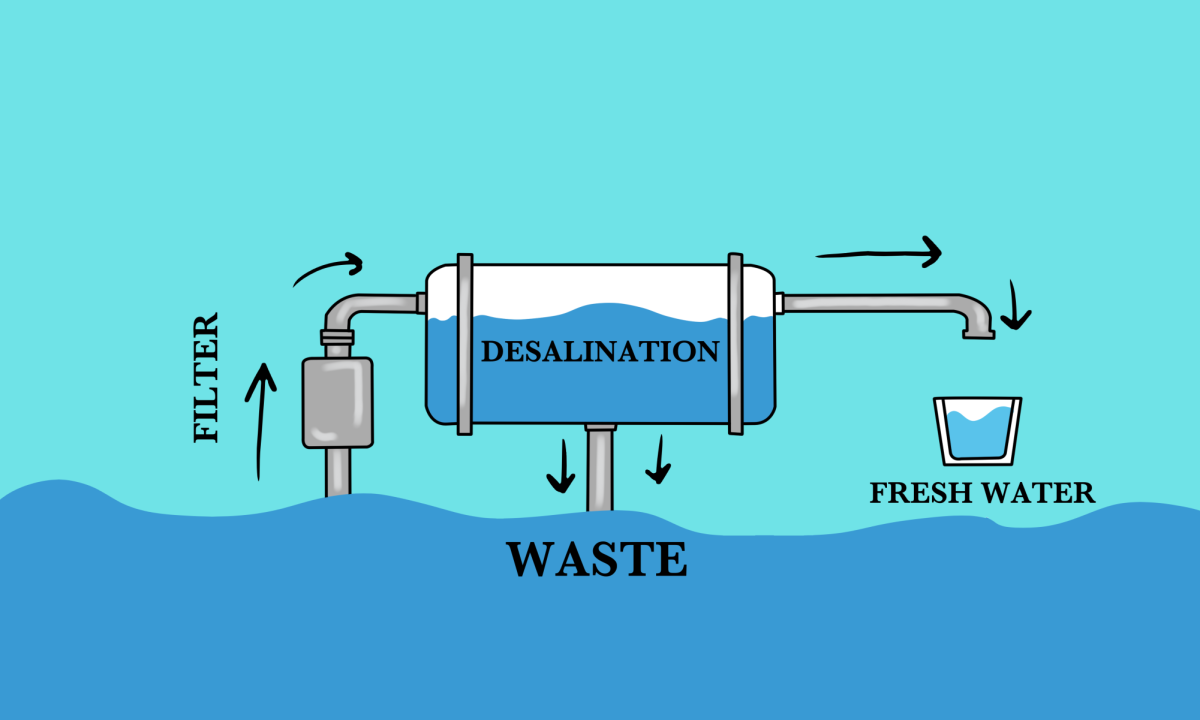
As droughts deepen and aquifers collapse, desalination has become the water solution everyone wants to believe in. The global desalination technologies market is projected to reach $59.34 billion by 2034, and the average desalination plant size is now 10 times larger than it was 15 years ago. Modern seawater reverse osmosis systems can produce freshwater at 40 cents-80 cents per cubic meter in larger-scale plants — competitive with conventional treatment. The engineering is real, and so is marketing. But scaling the technology this fast is creating environmental problems faster than we’re solving them.
Start with brine — water with high salt content. For every 95 million cubic meters of freshwater desalination plants produce, they generate 142 million cubic meters of brine each day, roughly 50% more waste, which is often laced with chemicals from the treatment process. Most of it is pumped back into the ocean. The Persian/Arabian Gulf is an important region for desalination, and surrounding countries host about 50% of global desalinated water, which is now a case study at this scale. Studies of discharge zones have shown significant declines in biodiversity, with corals and fish populations collapsing.
Then, there’s the energy. Only 1% of desalination plants currently run on low-carbon energy. The technology is energy-intensive by design. Separating salt from water requires enormous pressure, and pressure requires electricity. The International Energy Agency projects desalination could add 190 terawatt-hours of global electricity demand by 2035, which is equivalent to 60 million households. Under 3 C of warming, global desalination could emit up to 1 billion tons of CO2 annually, roughly 2.5% of today’s total energy-sector emissions.
Desalination isn’t optional for the Middle East, North Africa or parts of the American Southwest; water scarcity is real, and expansion is inevitable. But scaling without addressing brine or embracing renewables turns a climate-driven water crisis into an even greater environmental threat. We can’t solve a carbon-fueled crisis by compounding it. To move forward, we can’t mistake delay for progress. To ensure desalination benefits future generations, we must prioritize investment in sustainable disposal solutions and transition plants to renewable energy sources.
