


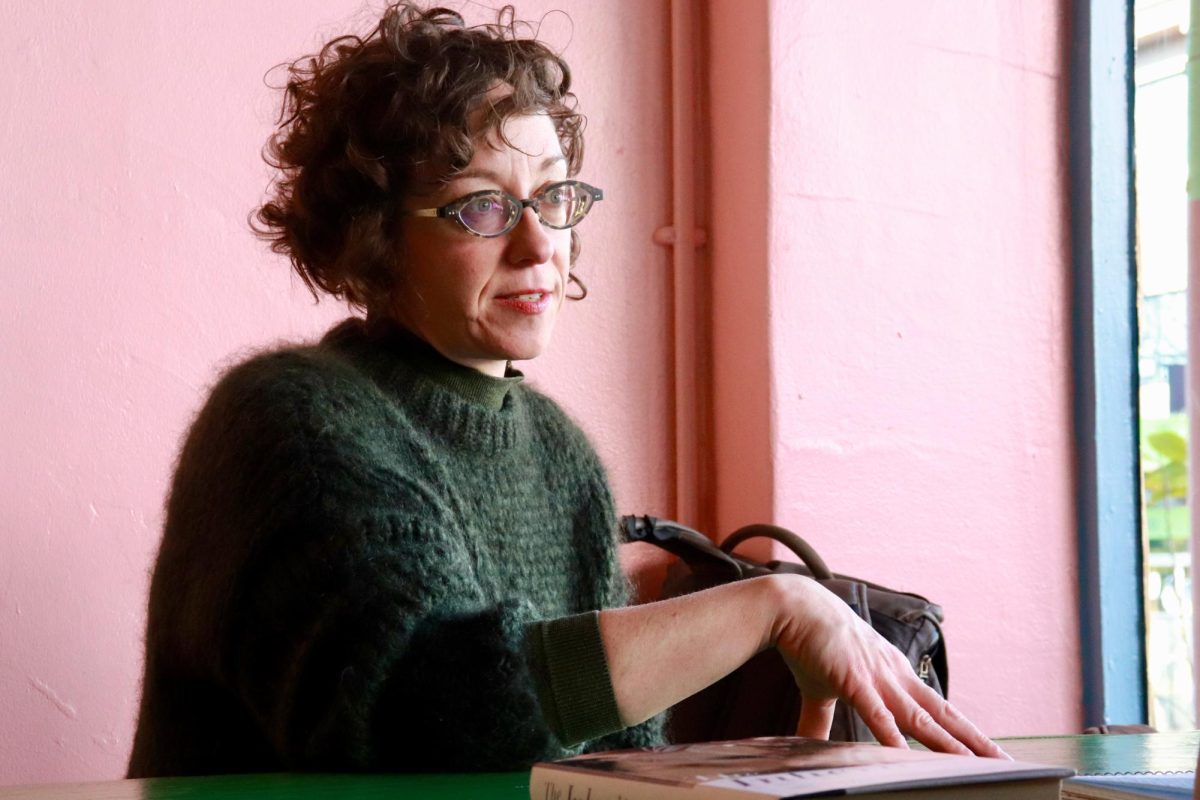










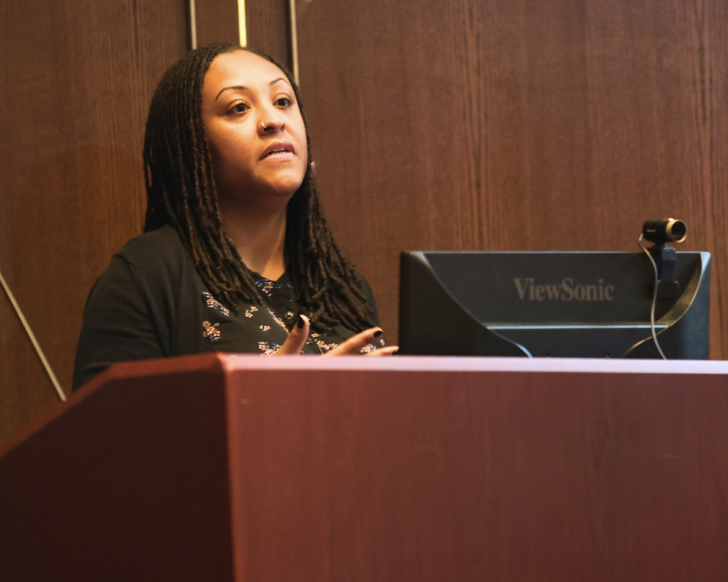
The St. Joe’s history department hosted a book talk by Erica Banks, Ph.D., assistant professor of sociology at Smith College for the Misher Festival of Arts and Humanities. Banks presented research from her first book, “Reverberations of Incarceration: The Carceral State and Black Womanhood” in the President’s Lounge of Campion Student Center March 20.
Banks, whose doctoral dissertation focused on the effects of incarceration on Black women, said even though they are disproportionately incarcerated like Black men, Black women’s experiences did not get as much attention in the conversations about mass incarceration.
“Black women were often talked about as family members who are trying to support the men in their lives, but you didn’t really hear about Black women themselves who got swept up into the system,” Banks said.
Black women are statistically overrepresented in the U.S. criminal justice system. In 2021, Black women accounted for about 13% of the female population but made up 29% of all incarcerated women. In 2023, the imprisonment rate for Black women was 1.7 times the rate of imprisonment for white women, according to the most recent data from The Sentencing Project.
Amber Abbas, Ph.D., associate professor of history and director of the Nealis Program in Asian Studies, said she invited Banks, her former student, to talk about her work and how it questions the system’s treatment of Black women.
“Women continue to live with the burdens of having been incarcerated, not just the emotional or the physical burdens and scars but the very real restrictions placed on their access to American opportunities, basic opportunities, housing, work, mothering,” Abbas said.
Banks’ presentation featured narratives of Black women who were previously incarcerated but continue to feel the impact of the experience decades later. Banks said many of the women she interviewed had worked hard to build successful careers and repair their relationships with their family members. Their prior incarceration, however, caused a social stigma that continued to negatively affect them.
“I think it was astounding to me that you can do all the right things, and you have technically proven yourself to be worthy, you’ve proven your value to society, and yet you’re still treated as somebody who’s irredeemable,” Banks said.
Kayla Bennecoff ’26 said she attended the presentation because she was interested in understanding incarceration and the criminal justice system.
“One thing I learned about today would be just the intersectionality that is occurring for Black mothers, especially for older women who have been formerly incarcerated, and the stigma that they face when returning home, even so many years later,” Bennecoff said.
Banks said her work centers the stories of Black women who have been long absent in American history. Her work aims to change society’s perception of Black women by understanding and humanizing their struggles.
“I think that’s going to be more difficult to change people’s minds in terms of how we view people who have done things that we view as harmful and difficult to forgive,” Banks said. “But my hope is that through trying to show the humanity of the women that I’ve interviewed, it becomes easier for people to do that.”
Abbas said she hopes for a similar outcome.
“There are people in this room who are not specialists on these topics,” Abbas said. “They’re not going to go write research papers. They’re not going to become sociologists. But if we, through our education, learn to see the world differently, then we will change the way we are with one another.”
