










Fredy Abboud ’25 still remembers the man in need of wound care he saw while walking along Allegheny Avenue in northeast Philadelphia two years ago.
Abboud, then a fellow for St. Joe’s Institute of Clinical Bioethics, was working at the ICB’s BIPOC health promoter, a free preventive healthcare clinic operating from the Mother of Mercy House in the Kensington neighborhood of Philadelphia. He recalled approaching the man to offer care from the health promoter team.
“Me being me, I said, ‘We have the clinic up [the street],” said Abboud, who now works as a bioethics intern for the ICB. “‘You can just walk up there.’”
Instead, the man pointed to a shopping cart filled with his belongings next to him. Because of the severe wounds on his legs, he could not push the cart up the street.
Abboud said this exchange opened his eyes and “set the tone” for his future career as a physician.
“I was so enclosed in my own box that I didn’t really realize what the needs of others were,” Abboud said. “In that particular case, this individual’s need was he needed wound care ASAP, and that wound care meant I had to meet him where he was.”
Gaps in traditional care
Abboud’s experience is just one example of the disconnect between conventional health systems and the lived realities of patients experiencing homelessness, illness or substance use disorder.
Andrew Peterson, Ph.D. ’09, PharmD, professor of pharmacy, said the gap is especially pronounced for those with substance use disorder who want to receive treatment medication, such as methadone, buprenorphine or naltrexone. Patients taking methadone, for example, are often required to go to a methadone clinic every day.
“Imagine a woman who has a couple of kids at home and is trying to recover from this and maintain herself on it,” Peterson said. “Every day, she’s got to get her kids off to school, but she’s also got to get to the methadone clinic, and that’s before she gets to work.”
When care depends on patients scheduling or traveling to appointments, some conditions may go untreated or worsen because the logistics of getting help are too difficult.
Substance use disorders also require continuous care. In traditional systems, once a patient is considered treated, they may receive little follow-up, Peterson said. This lack of long-term care can leave individuals without the support they need to sustain recovery.
A different approach
The ICB was founded in 2006 by Peter Clark ’75, S.J., Ph.D., to help patients falling through the cracks of traditional healthcare systems.
The institute began as a “mom and pop shop,” said Steven Silver, MBA ’25, who has been the assistant director of the ICB since 2022. Since then, the ICB has expanded to include five health promoters (BIPOC, Asian, African, Hispanic and a Hispanic mobile unit) and a wound care clinic.
Community-based approaches are designed to address the limitations of traditional healthcare systems by providing basic screenings and care in locations where patients already are. This approach reduces reliance on patient travel and helps identify and treat issues before they require emergency intervention.
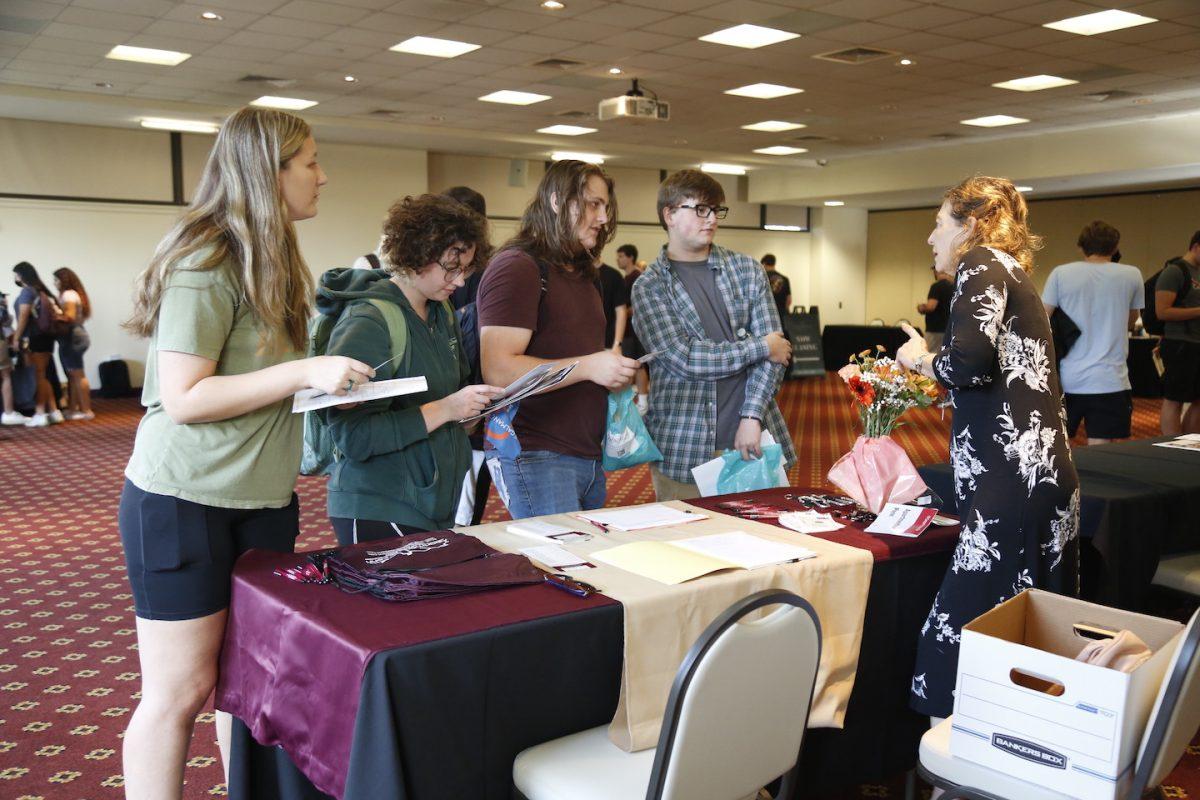
When patients arrive at one of the ICB clinics, they receive a health screening pamphlet that explains each station and has a spot to write down results. Patients move through stations for basic health screenings, like height, weight, BMI, blood pressure, pulse oximetry and glucose and cholesterol screenings.
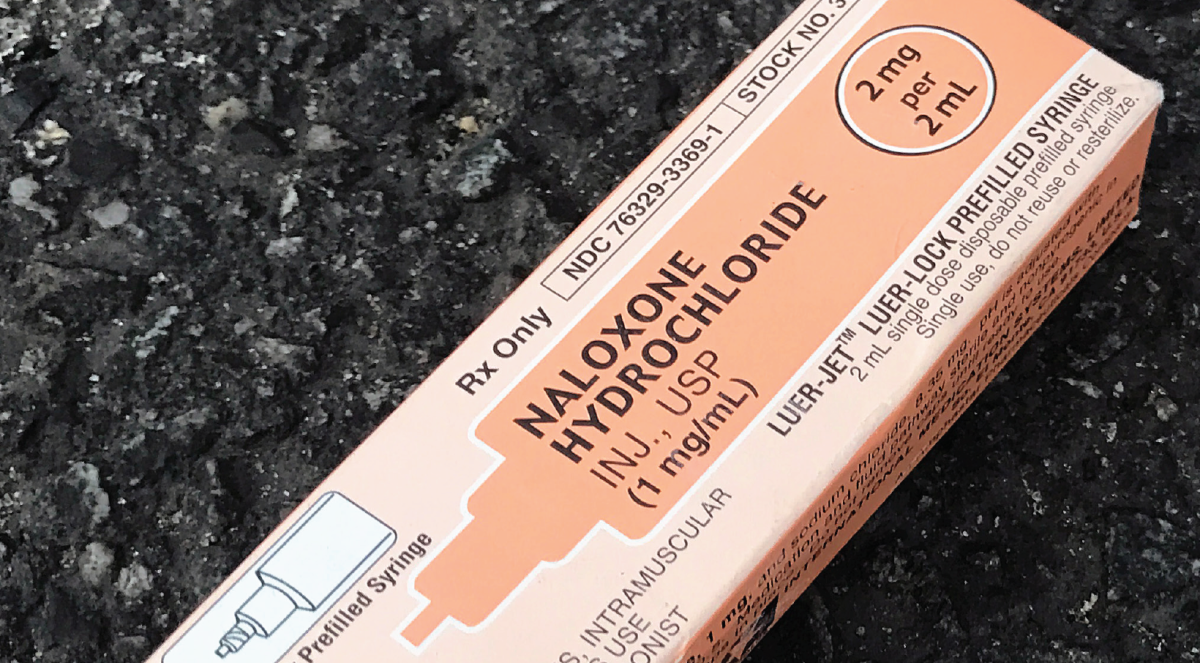
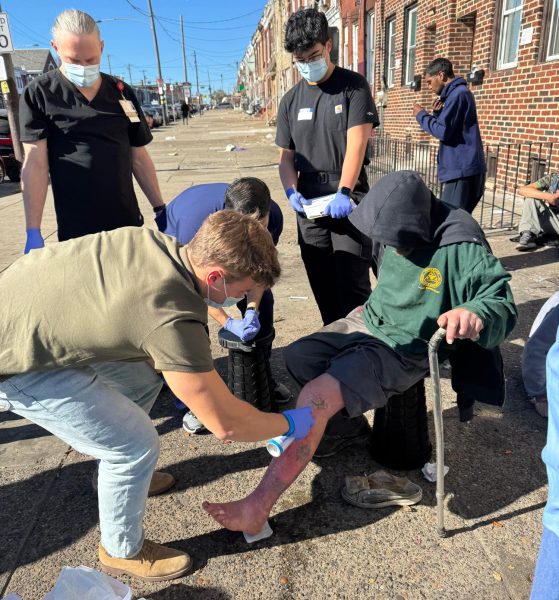
Patients can then meet with volunteer medical residents and pharmacy, physical therapy and occupational therapy students for additional screenings and consultations. The ICB also offers mental health assessments and, depending on the site, wound care, Narcan and referrals for further treatment.
The wound care clinic, which operates every Tuesday and Thursday in Kensington, serves many patients who use substances and frequently treats wounds caused by xylazine — a veterinary tranquilizer often found in opioids. They supply patients with materials such as gauze, antibacterial ointments, wipes and information on additional care resources.
For some patients, this care is transformative, said Ean Hudak ’26, an ICB fellow who is involved with the BIPOC health promoter program.
“‘I feel brand new,’” Hudak recalled a patient saying after receiving treatment. “‘I feel like I can conquer the world.’”
The ICB also stresses the importance of continuity of care.
“When we do screenings, we want to make sure that we don’t just identify an issue or a health concern with someone and not have anywhere to refer them to for further care,” Silver said.
The ICB partners with various organizations to provide further screenings the ICB doesn’t provide. One such partnership is with Penn Hematology/Oncology, which performs screenings on site for various cancers, like colorectal, cervical, breast, lung and prostate cancers.
For Clark, this model reflects a mission to serve that is rooted in action.
“Words are cheap,” Clark said. “I want to see the words into action.”
Barriers beyond access
Access alone does not determine whether patients seek care. Stigma also plays a role in whether patients seek care
“There are quite a few people within the system who still think of [substance use disorder] as a moral failing and that the person who is experiencing the disease has control over it,” Peterson said.
Language within healthcare settings further reinforces this negative perception, with terms like “addict” or “junkie” still used. Some pharmacists have even been hesitant to carry treatment medications such as Narcan or buprenorphine, Peterson said, because they do not want “those people” coming into their stores.
Public perception contributes to this stigma, too.
“[The media] were showing individuals who were downtrodden in Kensington … and that drives a picture in somebody’s head of what somebody with opioid use disorder or substance use disorder [is],” Peterson said.
Hudak said he sees firsthand the emotional challenge of guiding patients through unfamiliar or unwelcoming care systems.
“It’s nerve-racking,” Hudak said. “You’re leaving all your friends and family in the neighborhood to go off to some inpatient clinic or rehab where you don’t know anyone. You don’t know how it’s going to turn out.”
Healthcare professionals can play a role in reducing that stigma. Pharmacy students at St. Joe’s are educated about substance use disorder and are well-equipped to work with people impacted by this disease, Peterson said.
“What we need to do a better job is demonstrate that people with a substance use disorder are people like you and me and are living everyday lives and are managing it,” Peterson said.
For volunteers and participants at the ICB, interactions with community members reinforce that message.
“We’re here to just help them,” Abboud said. “We genuinely care for them. We are trying our best to get them out of the situation that they’re in.”
This is the fifth story in a series by Cara Santilli ’24, M.A. ’26, about social issues affecting the Philadelphia community, how the media reports on those issues and what the community can do to help.
Members of the St. Joe’s community seeking support are encouraged to contact the following resources:
Counseling and Psychological Services (CAPS), 610-660-1090
Campus Ministry, 610-660-1030
The Office of Student Outreach & Support, 610-660-1149
The Jesuit community, 610-660-1400
Employee Assistance Program, 866-799-2728