









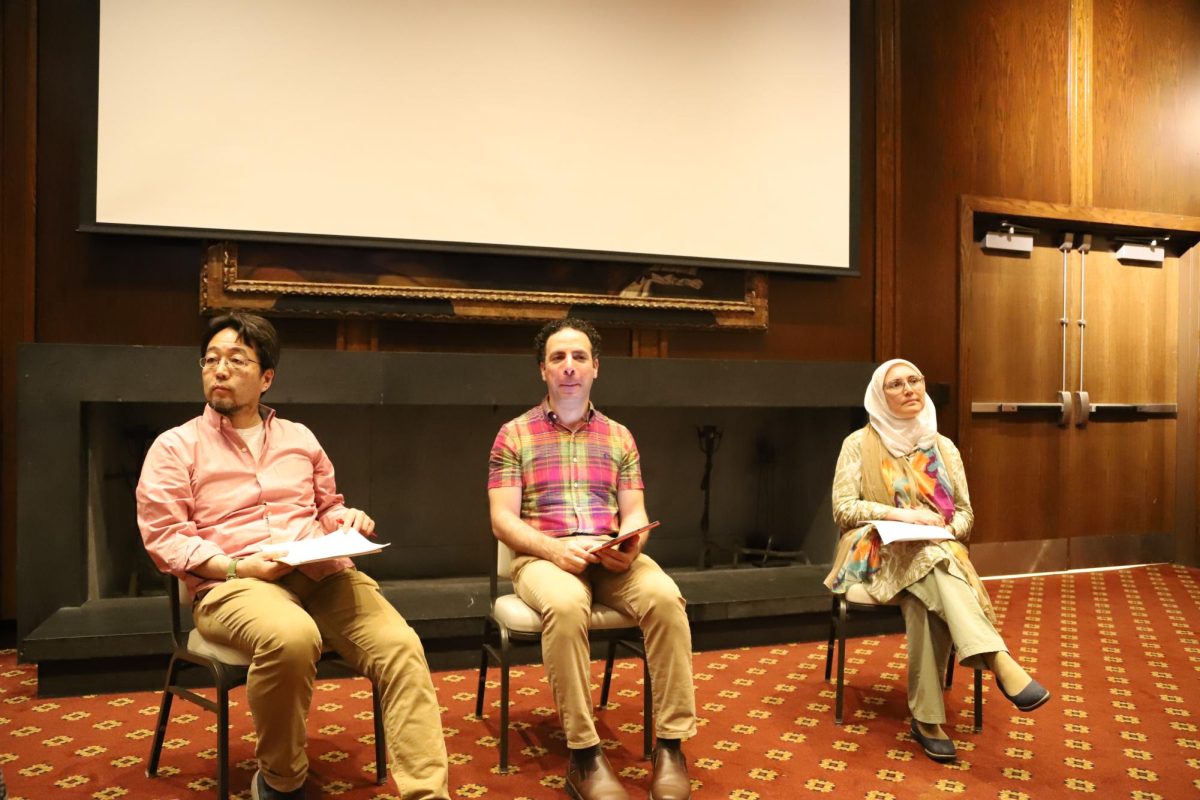
St. Joe’s department of political science, department of theology and religious studies and department of history hosted a panel on the current war against Iran in the President’s Lounge in Campion Student Center April 16 to give students a chance to learn about the conflict and ask questions.
The panelists were Kazuya Fukuoka, Ph.D., professor and chair of political science, Umeyye Isra Yazicioglu, Ph.D., associate professor of theology and religious studies and Yasser Sultan, Ph.D., postdoctoral fellow and visiting professor of history. Lisa Baglione, Ph.D., professor of political science, acted as moderator.
Baglione said panels like this give students a “glance” at an issue, given their complexity and time constraints for the panelists.
“The hope is that having the panel will encourage attendees to ask questions, reflect and learn more for themselves about what is going on,” Baglione said.
The war in Iran began Feb. 28 after the United States and Israel launched military strikes against Iran. President Donald Trump claimed the strikes were to prevent “imminent threats” from Iran, and Israeli Defense Minister Israel Katz described the attack as a “preemptive strike” to protect Israel from threats.
The Feb. 28 military strikes killed Iran’s Supreme Leader Ayatollah Ali Khamenei, who ruled Iran for over 30 years. Thousands of people in the Middle East have been killed since the beginning of the war.
Each panelist had roughly 20 minutes to speak. Fukuoka discussed the United Nations’ charter stances on self defense, aggression and the just war theory. Yazicioglu discussed the conflict through the lens of Quranic doctrine and teachings on warfare, and Sultan spoke about the history of United States-Iran relations in the 20th century.
Sultan began his portion by discussing the 1979 Iranian hostage crisis, in which Iranian students seized the American embassy and held over 50 hostages for 444 days. However, Sultan also acknowledged the relationship between Iran and the United States is considerably more complex and discussed the 1953 CIA-backed coup of Iran’s prime minister.
Sultan touched on the Trump administration’s calls for Iranians to rise against the Ayatollah and Trump’s later threat on social media to Iranians that “a whole civilization will die tonight.”
“When Trump threatened to annihilate their civilization, a population that had been marching in the streets against their own government marched instead to the bridges, to power stations to stand as human shields between their country and the planes,” Sultan said during his speaking portion.
Yazicioglu said panels like this are important for educating students as “citizens of the world” to be better able to make judgments.
“I think it was very important for the students to have some facts, history, some important principles clarified,” Yazicioglu said.
Nancy Fox, Ph.D., professor of economics, who helped organize the panel, said the College of Arts and Sciences has a role in making sure students are educated on global affairs and that the information they receive is accurate.
“Our students should know what’s going on in the war in Iran and why it’s being fought and how it’s being fought and the economic and the political and the ethical implications of it, and this is the way to do it,” Fox said.
Fukuoka acknowledged he is not an expert on the Middle East and that his goal was not to convince the audience of any particular stance but to encourage thought.
“I want you to think and come up with your own answers, and probably a question, too,” Fukuoka said during his speaking portion.” “My goal is to present frameworks that should help you arrive at your own informed conclusions.”
Annette Ciaccio ’27, an international relations major in attendance, said panels on complex issues help students learn from others who have different perspectives and give an opportunity to ask questions.
“I think we should always be questioning things when it comes to complicated ethical things like war,” Ciaccio said. “I think it’s important to ask difficult questions, and I definitely think some students got to do that.”