








When senior Kate Larroder was promoted last summer to editor-in-chief of The Columbia Chronicle — the independent student publication of Columbia College Chicago — she faced a challenge many of her peers in student media didn’t. Larroder, who is from the Philippines, feared losing her student visa over her organization’s immigration coverage.
Larroder, who is now campus news editor, was put on alert after the U.S. Department of Homeland Security announced it would be intensely vetting the social media accounts of international students. Prior to the announcement, Larroder wrote a story about safety worries expressed by international students under the Trump administration.
“I even debated whether to have that story taken down from the website, just because I was fearing for my safety,” Larroder said.
The March 25, 2025 detention of Rümeysa Öztürk, an international graduate student attending Tufts University who co-wrote an op-ed in The Tufts Daily about Palestine, increased Larroder’s fears.
“That really affected me as well because when that news came out, I didn’t go out of my apartment for multiple days, and I was just working from home,” Larroder said. “I had to tell my adviser that I need to step away from anything immigration related, or anything basically covering the government.”
Across the U.S., student journalists are navigating how to cover both national and local immigration stories. For student journalists, covering these stories can mean navigating personal and professional risk — shaping what they report, how they report it and whether they publish at all.
In Minnesota, a month-long federal deployment earlier this year brought thousands of U.S. Immigration and Customs Enforcement agents to the Minneapolis area, prompting protests and widespread community concern.
Student journalists like senior Sam Hill, managing editor of The Minnesota Daily at the University of Minnesota, said his newsroom prepared for the possibility that reporters could face volatile situations in the field.
“Students are affected the same as other folks,” Hill said. “There have been a lot of folks who have had families stopped or detained. There are a lot of students that have probably been stopped or taken away that we don’t know about because ICE doesn’t publish things, and people are afraid to talk to risk jeopardizing their own communities.”
The Minnesota Daily has dedicated ongoing coverage of local ICE activity, reporting on enforcement operations and their impact on students and the surrounding community. Other student news organizations, like The Chicago Maroon, the student publication of the University of Chicago, have digital maps tracking sightings of federal immigration agents near campus.
Junior Sofía Oyarzún, Larroder’s colleague and editor of La Crónica, The Columbia Chronicle’s Spanish language section, said it’s been “hard to ignore” surrounding threats such as ICE raids in Chicago.
“I think we’re all very aware because we come from families — immigrant families, or families with Latin heritage,” Oyarzún said. “I think the stories are in front of us.”
Oyarzún, who is a photojournalist, covered a protest at the Broadview detention center outside of Chicago that resulted in 21 arrests and four police injuries. Reporting this story, Oyarzún said, pushed her into a new kind of student journalism — one that felt more “real” and challenged her to adapt as a reporter.
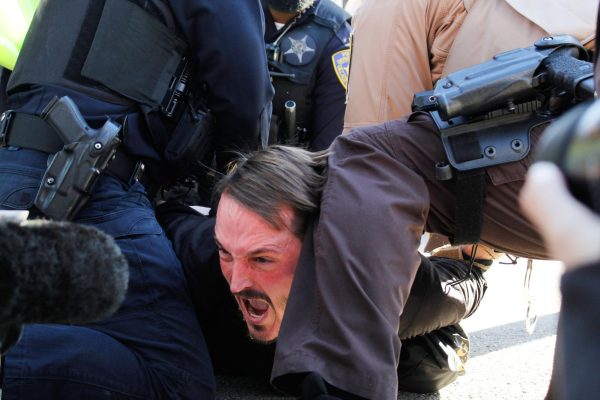
“That was my first time being in that kind of chaotic environment and taking photos in such a chaotic environment,” Oyarzún said. “I think I grew in a lot of ways at that protest because everyone next to me was being shoved to the ground or arrested.”
At Miami University in Oxford, Ohio, immigration coverage looks different. First-year Abe Hagood, assistant opinion editor and former staff writer at The Miami Student, said while there isn’t particularly high ICE activity surrounding campus, there are other immigration-related stories to cover, such as an article he wrote on the fears of international students.
“I was interested in how the students are reacting to ICE and the Trump administration,” Hagood said.
But Hagood said it was difficult to find international students to interview for his article, as many of them are scared. While Hagood’s source did not request anonymity, Hagood said The Miami Student’s staff would consider it for sensitive stories where sources could have safety concerns.
Dominic Coletti, student press program officer at the Foundation for Individual Rights and Expression, a nonprofit that works to defend free speech on college campuses, said FIRE received various inquiries in early 2025 about anonymous sourcing related to immigration coverage.
“While the policies are coming from the federal government, and a lot of the impact is beyond campuses, it’s still chilling expression in the pages of student newspapers on college quads and all across the higher ed space,” Coletti said.
The News Record at the University of Cincinnati has also focused on how federal immigration policies affect international students as well as student activism in the broader Cincinnati community, according to Editor-in-Chief junior Hajra Munir.
“I believe it’s important we are covering this issue like we would any other issue, despite it being politically charged and despite there being so many outside perspectives and voices affecting this issue,” Munir said.
Coverage by the Saint Peter’s Tribune at Saint Peter’s University in Jersey City, New Jersey, includes the university’s response to increased local ICE presence. Sophomore staff writer Jaelin-Renae Arceo said it’s the responsibility of student news organizations to inform students about the threats immigrants face.
“I just think that with everything going on in the world right now, it’s important to stay safe, especially as college students, to know our rights,” Arceo said.
Oyarzún said she feels like she’s done her job when community members feel comfortable and in control when sharing their stories.
This is the fifth article in a series by Hannah Pajtis ’26 that highlights immigration-related stories from the Philadelphia area.