









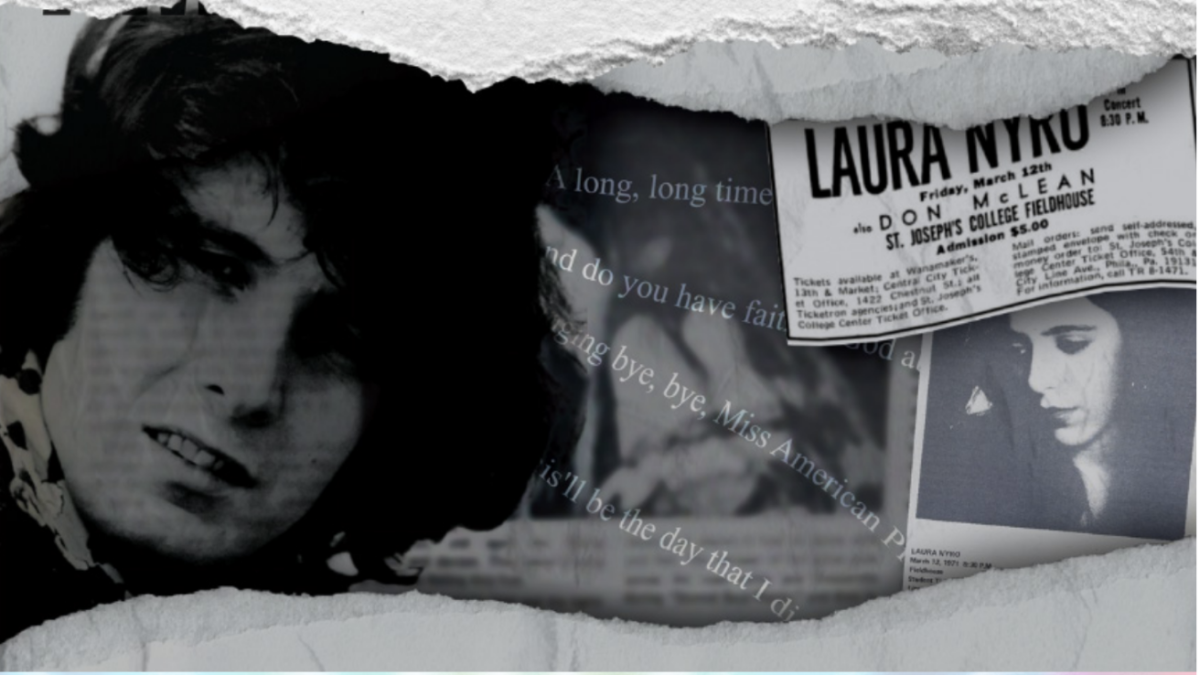
A long, long time ago — 55 years, to be exact — an American folk rock singer performed at St. Joe’s what would go on to be one of the most famous songs in the U.S.: “American Pie.”
On March 12, 1971, a young Don McLean, then relatively unknown, opened for singer and songwriter Laura Nyro in front of a sold-out crowd of over 3,200 people at St. Joe’s Fieldhouse, now Hagan Arena.
On page eight of the March 23, 1971, issue of The Hawk, located in the St. Joe’s Archives and Special Collections, is a story about the concert, along with a photo of Nyro. The reporter, Mary Deane Conners ’74, doesn’t mention what song McLean performed that night but describes it as “pleasant” and “intimate.”
Whether that song was actually “American Pie,” and whether McLean debuted it at St. Joe’s, depends on who you ask. In fact, in one interview in 2011, someone asked McLean where he first debuted the song, and he said Temple University.
“It was written in Cold Spring, New York, and in Philadelphia, and it was performed first at Temple University when I was just getting started with Laura Nyro,” McClean told an interviewer for the NPR show “Talk of the Nation” in 2011.
The problem is, there is no evidence to corroborate McLean’s memory. No evidence Nyro performed anywhere else in Philadelphia during her 1971 tour. No evidence she and McLean did a concert at Temple. Nothing in The Drummer, a Philadelphia-based countercultural underground newspaper that covered the local music and arts scene. Nothing in The Temple News, Temple’s own student newspaper.
Kimberly Tully, librarian and curator of rare books at Temple University, couldn’t find any proof of the concert in Temple’s archives.
“Unfortunately, I wasn’t able to find anything about the performance in question,” Tully said.
There is, however, ample evidence the concert took place at St. Joe’s.
In The Drummer, ads promoted McLean opening for Nyro at St. Joe’s Fieldhouse March 12, 1971.
According to the ads, tickets were available for $5 by mail order or at the Wanamaker Building in Center City Philadelphia as well as on campus at the St. Joseph’s College Center Ticket Office.
Conners reports in The Hawk’s concert review that it seemed as though McLean was singing a song that night he wasn’t familiar with, judging from the fact he asked an audience member to accompany him on stage and hold the lyrics for him.
That’s how Bill Kirk ’72, who attended the concert, remembers it: McLean handing off the lyrics to the newly written tune he recalls being “American Pie.”
“My faint recollection is that Don McLean did some ‘stage business’ with papers that supposedly had the ‘American Pie’ lyrics, maybe asking someone from the audience, possibly a plant, to hold them for him to read as he played?” Kirk wrote in an email to The Hawk. “The obvious gimmick would be that the song was too long and too new for him to know it by heart. That seems a little too contrived but all in good fun, of course.”
Clark DeLeon, a 1972 graduate of Temple who attended the St. Joe’s concert, wrote about it in an Aug. 12, 2012, column for the Philadelphia Inquirer. He also believes this was the first time McLean sang “American Pie,” which hit #1 on the Billboard Hot 100 Jan. 15, 1972 and remained there for four weeks.
“I didn’t have a clue what he was singing about, but like everyone else in the audience, I was singing along when he rolled around to the catchy refrain, ‘Bye, bye Miss American Pie,’ DeLeon wrote in the column.
DeLeon tells this story again in a 2022 documentary about the song, “The Day the Music Died: The Story of Don McLean’s American Pie,” directed by Mark Moormann. And so, the documentary confirms the debut at St. Joe’s, too.
Carmen Croce ’71, university relations liaison, was at the March 1971 concert, but he doesn’t remember the details.
“We did hear ‘American Pie’ in the Fieldhouse in 1971 but don’t remember because we were too anxious for Laura Nyro to perform,” Croce said.
Because there’s no recording of the concert, you’re just going to have to have some faith in God above that McLean did debut “American Pie” at St. Joe’s.
“Sometimes, we need to live in the mystery,” said Lesely Carey, St. Joe’s archivist. “But I am not a journalist.”
And that is a truth that, like the Hawk, will never die.