


















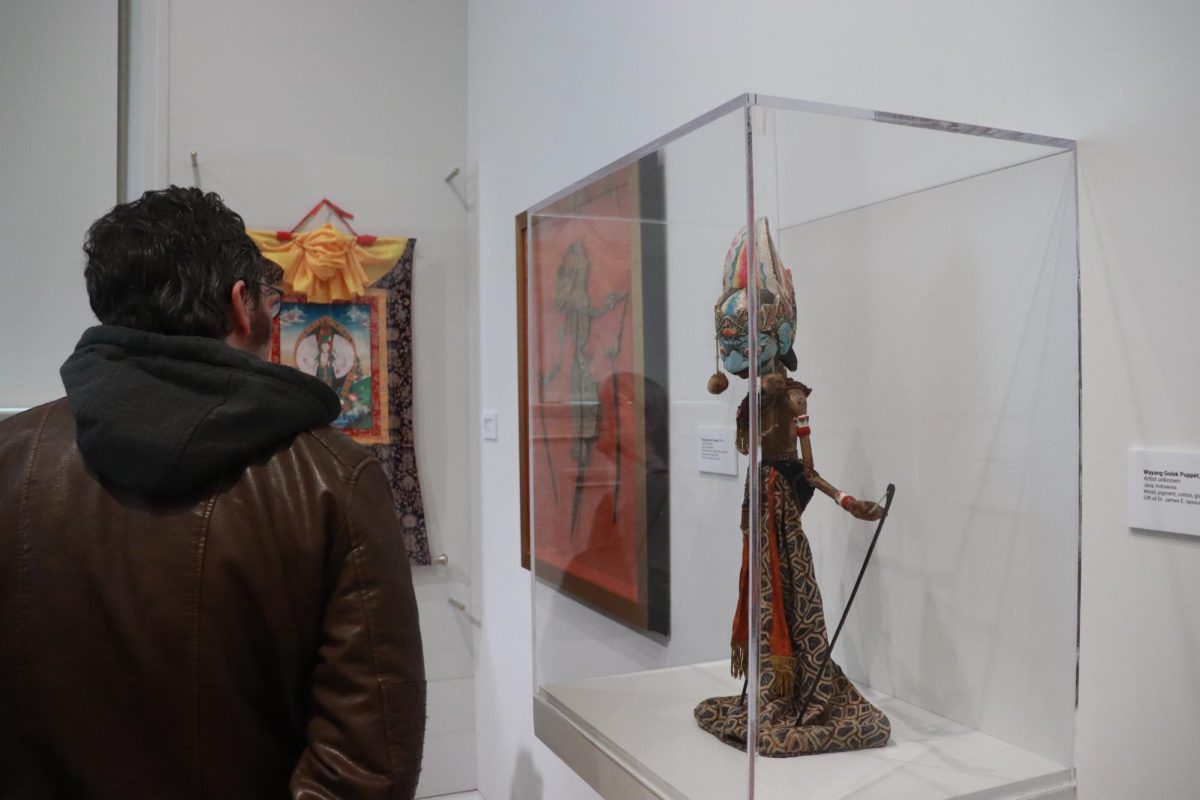
As community members enter the second floor of the Frances M. Maguire Art Museum, they are greeted with a gallery showcasing 20th century Japanese woodblock prints, Indonesian shadow puppets and Tibetan Buddhist thangka paintings. These art pieces are part of the museum’s first permanent Asian Art Gallery.
The Maguire Art Museum, in collaboration with the Nealis Program in Asian Studies, held an opening reception Nov. 14. For Amber Abbas, Ph.D., associate professor of history and director of the Nealis Program, the gallery represents a permanent location for Asian Studies in the St. Joe’s community.
“My goal as director has always been to use the Asian Studies Program to create connections throughout the institution and the community, and the events that we’ve hosted in the last few years have really highlighted that …To have the gallery as a permanent manifestation of the work that we’ve done really shows that it matters to us,” Abbas said.
The Asian Art Gallery is not just for visitors and students but also for faculty to incorporate into their curriculums, said Jane Allen, education and community engagement coordinator of the Maguire Art Museum.
“The other really important part to us is that this gallery is able to be used as a teaching gallery, and so faculty can come use it when they’re talking about history or art or Asian cultures in any way,” Allen said.
In the Great Hall, there was a ceremonial sweeping away of a sand medicine mandala, a ritual gesture encompassing impermanence, an integral Buddhist virtue. It was led by Tibetan artist Losang Samten, who spent the week at St. Joe’s constructing the mandela. Sand mandalas are an ancient and sacred Tibetan art form using colored sand, which symbolizes not just impermanence but spiritual healing and purification.
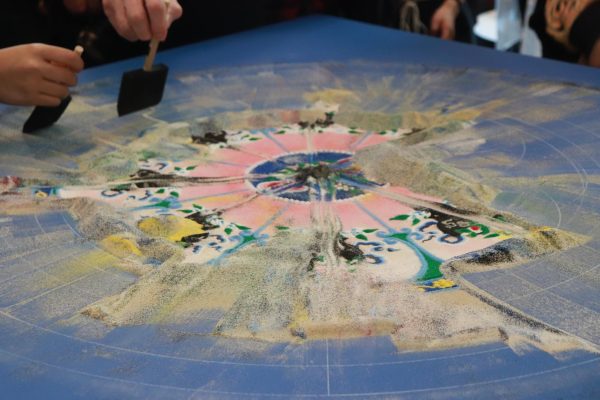
The Buddhist ritual is something that students like David Soler ’26, an Asian Studies student worker, resonate with their education.
“This semester, the Asian Studies Program has been covering this topic of health, healing in the body in Asia,” Soler said. “Seeing a healing mandala being brought to life definitely connects with all that we’ve been working [on] this semester.”
Further, the Asian Art Gallery represents “globalization” to Soler, as he looks forward to seeing cultures become more alive on campus.
“Being able to see all of this new Asian representation that’s coming in through all these really creative and really cool ways is really exciting to see and really cool to be a part of,” Soler said. “It really just shows that St. Joseph’s is progressing more and more every day and being in touch with those Jesuit values that they always talk about so proudly.”
To other students like Owen Monson ’28, the art exhibit represents the growth of the Asian Studies Program.
“It really does represent the growth of the study of Asia, of its cultures, its people, even questions of, ‘What is this identity and what we can learn from it?’” Monson said. “The artifacts that are up there really do resonate with how culturally diverse it is.”
The diverse and “interconnected” nature of the Asian continent, Abbas said, is reflected through the collaboration of many different programs at St. Joe’s.
“The collaboration that we do here in the university between the Asian Studies Program, the museum, other departments, institutions, programs, it’s the way Asia has always been,” Abbas said. “To me, it’s fundamental. It’s not special work. It’s just our work.”
Abbas said the Asian Art Gallery not only allows connections between cultures but also reflects a greater representation of students of Asian descent at St. Joe’s.
“I think, especially now that it’s been a couple of years since our mergers with USciences and PA College, that we have a greater representation of students with Asian heritage on our campus,” Abbas said. “So, it also allows us, as a predominantly white university, to create those connections, and that’s incredibly important.”