







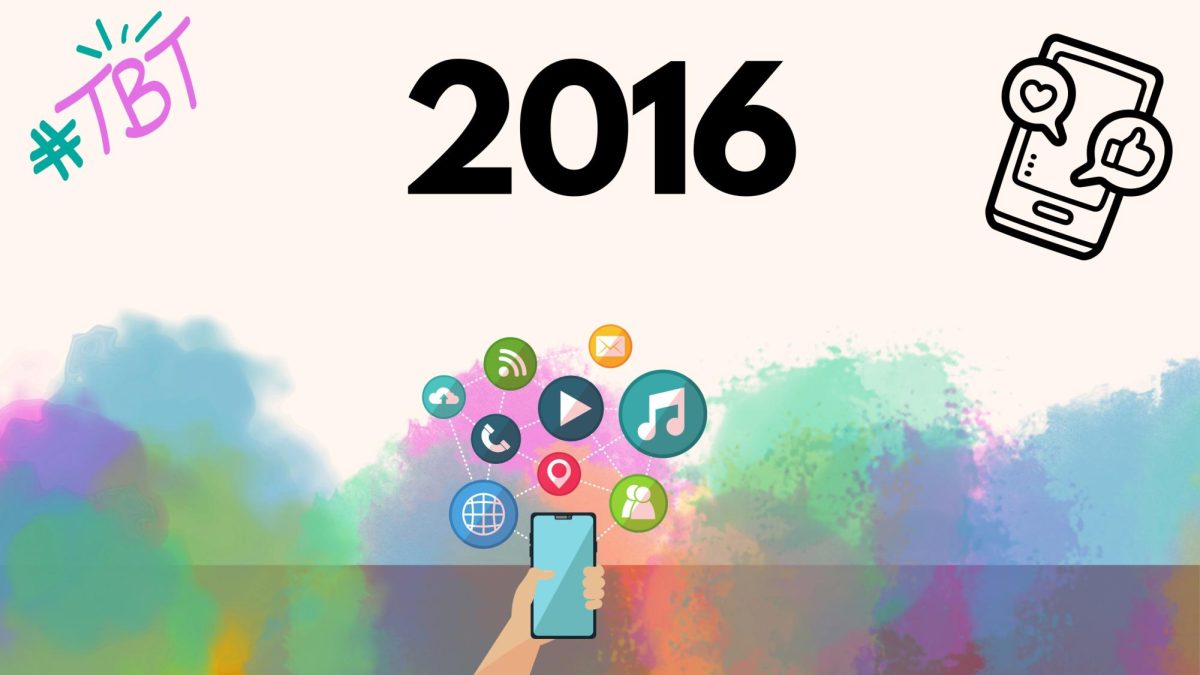
Three months into 2026, the feeling of nostalgia has hit social media users like a tidal wave, with many deciding to rewind the clock to 10 years ago.
Back in 2016, Justin Bieber, Drake and Rihanna were topping the Billboard Hot 100, and Pokémon Go was on everyone’s phones. Meanwhile, people were either using Snapchat’s dog filter or recording themselves doing the “mannequin challenge.”
The “2026 is the new 2016” trend consists of people posting photos and videos that reminisce about a time that seemed simpler.
Students like Gabriella Sormillon ’27, who was heading into sixth grade ten years ago, were already online at a young age.
“I remember that’s when Musical.ly was a thing,” Sormillon said. “That’s one of the things that [my friends and I] were doing. I also remember … the Kylie Jenner Lip Kits had just come out, and my best friend at the time got one. I was so jealous because I wanted one, but my mom wouldn’t let me have one.”
Musical.ly was a social media app released in 2014, where users could create lip-sync videos and post them to their accounts. In 2017, Musical.ly was acquired by Bytedance and subsequently merged with TikTok in 2018.
The hashtag #2016 has more than two million posts on TikTok and over 38 million posts on Instagram. A filter named “2016,” a saturated blue and purple filter, has also been used on 239 million TikTok videos.
In terms of the intended use of social media, Sormillon believes the current culture is more transactional.
“In 2016, it was just for kicks and giggles,” Sormillion said. “And now, being a marketing major, it’s used for marketing strategies. The point is to get views and gain followers and get your business or brand ahead.”
The 2016 experience of Steven Hammer, Ph.D, associate professor of communication and media studies, was less about social media. Rather, it revolved around live music, with Hammer seeing music shows “twice a week” before the pandemic hampered live music’s presence both financially and socially, changing the arts scene.
Hammer thinks the trend has something substantial and reflects the times that we’re living in.
“Be aware of what’s going on,” Hammer said. “Try to understand the trend and how it affects real people.”
Rachael Sullivan, Ph.D., assistant professor of communication and media studies said the cyclical nature of trends is common.
“Trends cycle through every generation,” Sullivan said. “Things that were popular 10 or 15 years ago are coming back around.”
For Sullivan, the trend reminded her of the “Turn the Lights Off” meme, which originated from a scene from TV show “Your Friends & Neighbors,” featuring actor Jon Hamm. Sullivan believes the meme showcases a dissatisfaction with the current state of the world.
“I can’t speak for other generations, but for millennials, that meme hits so hard because I think there is a real sadness and anxiety that a lot of people are feeling, like a sense of desperation,” Sullivan said. “I think that meme in particular captured that sense of going back in time where we could just close our eyes and move to a different moment.”