
















A headline on the front page of the first-ever April Fools’ issue of The Hawk, published in 1953, reads: “Red Birds Flushed Out By Hawk Agent.”
The article was poking fun at McCarthyism, an early 1950s campaign led by U.S. Senator Joseph McCarthy that accused people of being communists, often without proof.
The 1953 edition also featured stories about a new chemical element, “Hawkolinium,” and introduced to the community a new faculty member, Harry S. Truman.
On and off for the next 57 years, St. Joe’s readers could pick up The Hawk’s annual satirical edition every April 1. Copies of these issues are found in St. Joe’s Archives and Special Collections.
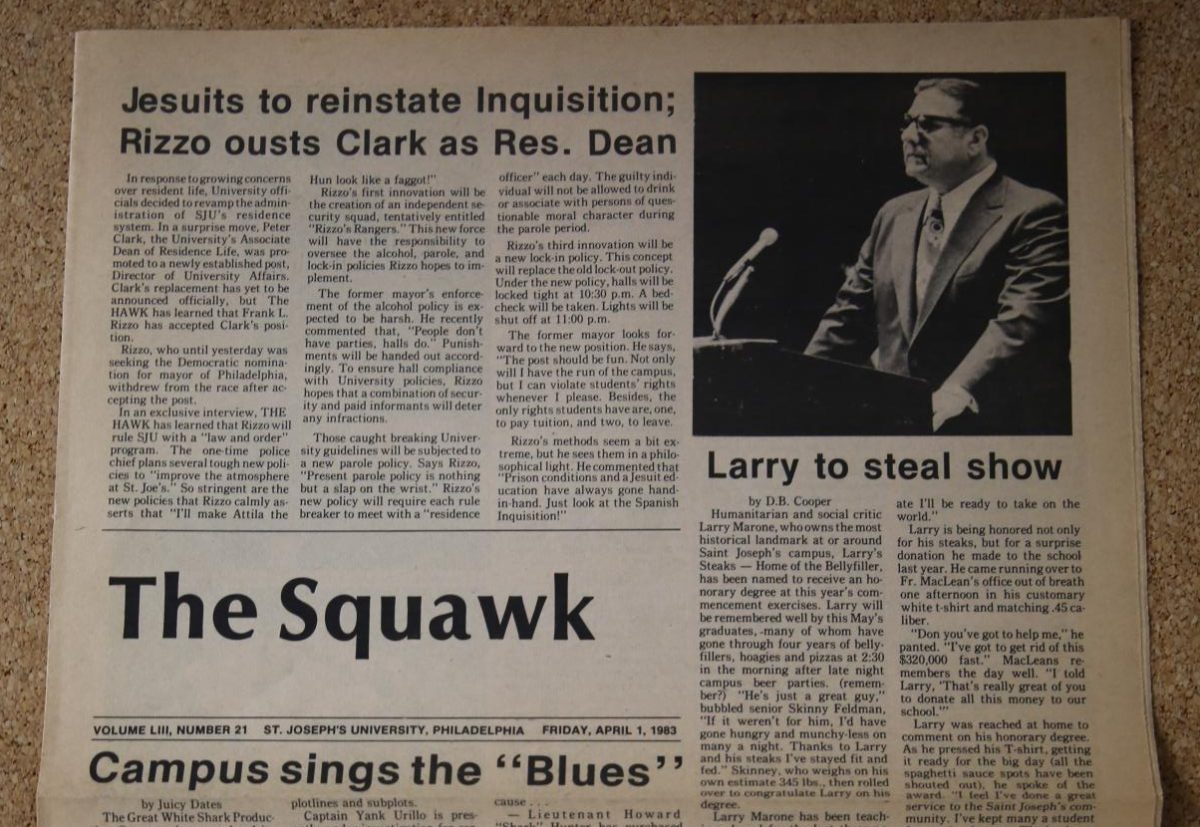
On April 1, 1983, The Hawk renamed the April Fools’ edition to “The Squawk.” The issue that year included headlines like “Jesuits to reinstate Inquisition” and featured comedic drawings of life on campus, including St. Joe’s hawk mascot perched on Barbelin Hall.
Owen Gilman, Ph.D., retired professor of English and then-faculty advisor of The Hawk, said the name change was to prevent confusion over the content in the April Fools’ editions.
“The perfect way to cue people into what’s going on was to call it The Squawk,” Gilman said.
Gilman said staff members always loved putting together the issue.
“They could exercise their sense of humor and have a kind of playful engagement of what they took very, very, very seriously,” Gilman said.
Still, the April Fools’ edition managed to ruffle some Hawk feathers over the years.
In 2007, a headline buried on page three of the April Fools’ issue read: “Cardinal Rigali: ‘I’m Gay.’”
The issue of the paper was delivered to newsstands March 28, two days before Cardinal Justin Francis Rigali, then archbishop of the Archdiocese of Philadelphia, visited St. Joe’s campus.
Other content in the April 1 issue included an opinions column comparing Jesuits to Nazis and a condom advertisement featuring the words “Spirit. Intellect. Pleasure” alongside a picture of then-University President Timothy Lannon, S.J., with the caption, “I approve of this product.”
The regular April 4, 2007, issue of The Hawk featured an apology.
“I, as Editor in Chief of The Hawk Newspaper, would like to apologize for the inappropriateness of last week’s Squawk and the offense taken as a result of it,” wrote then-Editor-in-Chief David Spain ’08.
An email chain between faculty and deans in the Archives shows a number of administrators lamenting the issue’s “bad taste.” Lannon wrote that he was “deeply embarrassed and disappointed by what our students did.”
Jenny Spinner, Ph.D., professor of English and then-new adviser of The Hawk, said faculty advisers did not review content of The Squawk before it was published. However, they still had to help clean up the mess when The Squawk misjudged its landing. She said she urged the editors to drop The Squawk.
“Publishing an April Fools’ edition really harmed The Hawk’s ability to position itself as a credible news organization,” Spinner said.
Three years later, in 2010, the last full issue of The Squawk was published. Under The Squawk masthead is a warning in big red font that reads: “This issue contains satirical content, spoofs, lampoons, and/or caricatures. Anyone who thinks this is real news is an idiot.”
Headlines in this issue include: “Aramark not even for the dogs” and “Business students protest oppressive academic conditions.” The issue also featured an ad poking fun at David Carpenter, Ph.D., professor emeritus of theology and religious studies, for his collection of plaid shirts.
In 2015 and 2016, The Squawk reappeared briefly as a cover wrap — a front and back cover wrapped around the real newspaper — when Dan Reimold, Ph.D., served as The Hawk adviser before he died unexpectedly in August 2015.
“The Squawk was a breath of fresh air,” Gilman said. “Livelihood, humor, all in line with the spirit of April Fools.’”
Spinner takes responsibility for “killing the joy” The Squawk brought to readers and staff writers. But continuing controversies over its content ultimately prevented The Hawk from being viewed as a legitimate news source on campus, she said.
“It was fun, until it wasn’t,” Spinner said.
And that’s no joke.